GuidePart of Mental Survival Games
What Is a Mental Survival Game?
Mental survival games explained: how they differ from puzzle games and brain-training apps, what makes them tense, and examples of the format.
Short answer
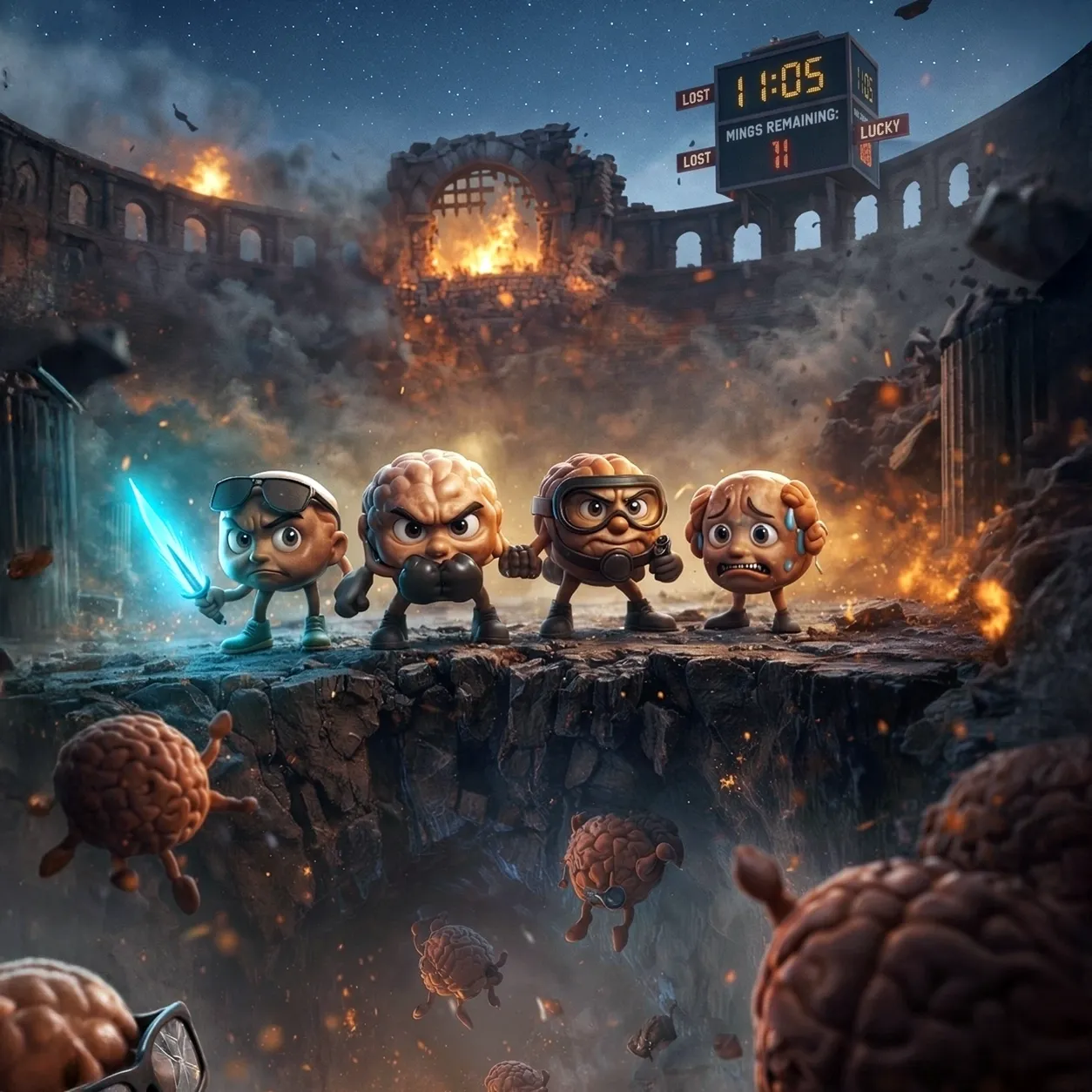
A mental survival game is one where your thinking is under threat: you face quick mental challenges with limited time and limited room for error, and the goal is to last as long as possible as the difficulty and pressure rise. The tension comes from survival stakes, not from how hard any single puzzle is.
You know survival games: limited resources, rising danger, the goal of lasting one more night. A mental survival game takes that structure and swaps the resources for your attention and judgement. Instead of food and ammo, you’re managing health, time and composure.
The defining ingredients
- Short mental challenges. Compare numbers, spot a pattern, react to a change. Each one is usually simple.
- Hard limits. A countdown, a health bar or a fixed number of mistakes allowed.
- Escalation. Difficulty, speed or pressure rises the longer you last.
- Instability. Rules, visuals or conditions change, so you can’t run on autopilot.
- Survival as the goal. Success is measured by how far you get, not by solving one hard problem.
How it differs from puzzle games
A classic puzzle game gives you a hard problem and lets you think. The challenge is depth. A mental survival game gives you easy problems and takes away your thinking time. The challenge is pressure. Someone brilliant at Sudoku can struggle badly with a two-second “which sum is bigger?” when they’re down to their last heart.
How it differs from brain-training apps
Brain-training apps present exercises as self-improvement and track your scores over weeks. Mental survival games are entertainment: competitive, tense and often chaotic. They don’t need to promise you’ll get smarter, and the honest ones don’t. (More on that in brain training apps vs brain games.)
Why people like them
- Short and intense. A run can be over in a few minutes, so they fit gaps in the day.
- Clear feedback. You know exactly when and why you failed.
- Rivalry. Many add leaderboards or head-to-head modes.
- The “one more go” feeling. Survival formats make near-misses sting in a motivating way.
An example: Mindboo
We make Mindboo, which describes itself as a fast-paced mental survival game. Its challenges — comparing values, matching shapes, following arrows, reacting to surprises — are deliberately simple. What makes them hard is the context: a pressure gauge that climbs, a countdown, a health counter, rules that flip, and in the Online Arena, real rivals raising the stakes. The core idea is in its own tagline: the brain is the weapon, pressure is the challenge, survival is the goal.
See how a Mindboo run works if you’d like to judge the format for yourself.
Questions players ask
What are examples of mental survival games?
Mindboo describes itself as a mental survival game. Many games use parts of the format — timed brain games, escalating puzzles — without the full survival structure.
Is a mental survival game the same as a horror survival game?
No. There’s no horror or combat; the 'survival' is lasting as long as possible against time, health and rising pressure.
Are mental survival games good for short sessions?
Usually, yes. Runs and challenges tend to be short, with a clear end when you run out of health or time.
Sources
Mindboo publishes this site. When we mention our own game we say so; we do not rank Mindboo above other games without a stated reason.